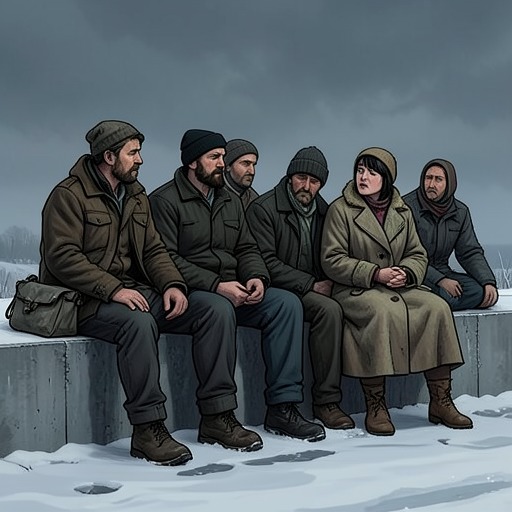
Vagrancy Act 1824
The Salt PathThe Vagrancy Act 1824 is a surviving instrument for policing people whose poverty makes them visible in public or leaves them without conventional shelter. In the book, its history connects the criminalization of homelessness to a wider pattern: people may be counted, moved on, or punished for lacking a home, even as their need for somewhere safe to stay goes unmet.
Historical development
The Act emerged from a long succession of measures against people treated as suspicious in public spaces. The account traces legislation against begging to the Peasants’ Revolt of 1381, followed by anti-vagrancy measures in 1547 after the Dissolution of the Monasteries. As homelessness increased alongside the Enclosure Acts and the Industrial Revolution, laws against vagrancy expanded too.
An Act of 1744 established a template for later legislation. It classified homeless people under stigmatizing categories that included beggars, idle people, vagabonds and rogues, with repeat offenders designated as incorrigible rogues. Authorities could arrest people they considered suspicious or thought unable to support themselves. The book also notes an incentive that intensified enforcement: since 1713, local authorities had been required to pay five shillings to anyone who apprehended a person deemed idle or disreputable. In one year, more than five hundred people were arrested.
After homelessness rose again at the end of the Napoleonic Wars, calls for stricter measures led to the Vagrancy Act 1824. Though amended over time, it remained partly in force at the time of the narrative. Its longevity makes it more than a historical relic: the book describes provisions still being used to regulate begging and the presence of people without secure accommodation.
Provisions and enforcement
Section One, used alongside the Criminal Justice Act of 1982, addresses people begging or gathering alms in public places. Section Four covers people without visible means of subsistence who lodge in places such as barns, deserted or unoccupied buildings, open air, tents, carts or wagons and cannot give a satisfactory account of themselves. The law thus reaches beyond begging on a street corner: sleeping outside or in makeshift shelter can also fall within its terms.
The categories turn material hardship into grounds for suspicion. A person’s lack of conventional accommodation and means of support becomes not only evidence of need but a condition that can attract police attention. The Act’s language and reach reflect the older logic of vagrancy laws: regulating people who are poor, mobile, or unable to demonstrate an accepted form of livelihood.
The book places the 1824 Act within a broader contemporary landscape of powers over public space. The Anti-social Behaviour, Crime and Policing Act 2014 introduced Public Space Protection Orders, which allow authorities to direct people deemed to be causing a nuisance to leave an area and not return. The account describes such orders being used against activities associated with homelessness, including rough sleeping, begging and loitering. They may carry a fine of one hundred pounds, rising to one thousand pounds and a criminal record for non-payment. These orders are a separate legal measure, but the book presents them as part of the same continuing pressure to exclude homeless people from public places.
Homelessness beyond the stereotype
The Act’s reach is set against a public image that reduces homelessness to a person sleeping in a doorway, perhaps with a dog and asking for money. The book argues that this familiar stereotype shapes reactions ranging from discomfort to aggression, while obscuring how many different circumstances can leave someone without a home. It also challenges the assumption that addiction or mental illness is necessarily the cause: such problems may instead follow from homelessness.
The figures discussed in the book show how much depends on the method of counting. In 2013, at least 280,000 UK households had applied for help because they were homeless or at risk of homelessness. Officials accepted 52,000 as statutorily homeless; many of the remaining 228,000 received help through a local-authority relief route. These were household figures, not a count of individuals. Government estimates recorded 2,414 people sleeping rough across England on a single night, while the Homelessness and Information Network, funded by the Greater London Authority, recorded 6,508 people sleeping rough in London during 2013. A snapshot-based government count for London gave the much lower figure of 543. The discrepancies leave people in temporary, hidden or unrecorded situations difficult to see in official totals.
The law alongside lived conditions
The narrative’s account of homelessness includes circumstances that do not fit the image of a person bedding down on a city street. After losing their home, the narrator and Moth found that long-term camping would cost eighty pounds a week, without housing benefit to cover campsite fees. Renting was effectively out of reach after repossession damaged their credit rating; the council’s available offer was a bed-and-breakfast room, and the couple chose the tent instead. Their situation shows how housing exclusion can push people towards forms of shelter that the law itself names as grounds for suspicion, even when they are trying to find a place to stay rather than solicit money.
A forest camp provides another view of the same problem. John, a lifelong farm worker, became homeless after the farm where he lived was sold and its houses were separated from the land and bought as second homes. Later jobs did not include housing, and his wages could not cover rural rents. He began camping in the woods; others joined, forming a shifting community of tents, tarpaulins and shelters made from fallen branches. The book reports that a local council wanted to clear people from woodland to create public-access space, while the need identified by those discussing the camp was for overnight shelters. This account makes the conflict concrete: authorities may treat a camp as a public-order problem even when its residents have few viable alternatives.
The narrator connects such enforcement to fear of homelessness and concern about its effect on tourism, noting attempts by central London authorities to ban rough sleeping and make soup kitchens illegal. The Vagrancy Act 1824 therefore stands in the book not only for particular offences, but for a durable way of seeing deprivation: the person without a home is treated as a threat to order or appearance, while the need for shelter remains unresolved.